Look for the comic’s defects
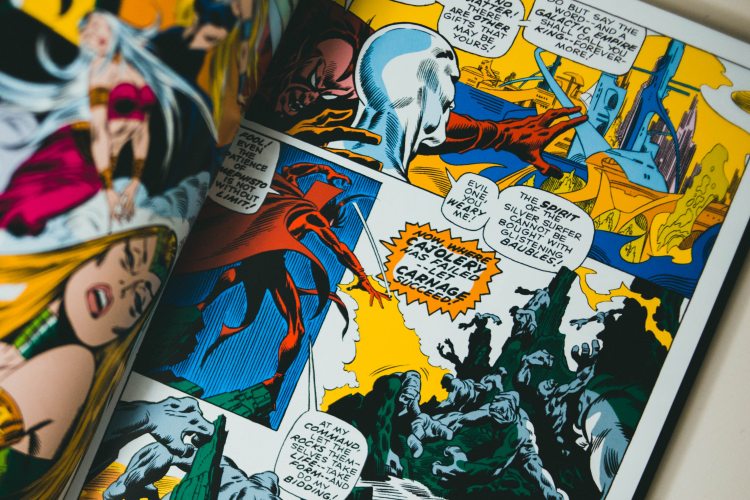
You can’t accurately grade a comic from a photograph or if it’s in a bag. You’ll have to handle it. First wash and dry your hands – you don’t want to leave oily fingerprints or sweat stains behind, but you do want to be able to feel for dents, imperfections, glue, and residues. Latex gloves may be a hinderence.
If you think the comic may be high grade, VF or better, COUNT the individual defects. If you find more than 8 different defects, it’s below VF grade – stop counting!
Lay the comic flat, on a clean surface, face up and face down – is it perfectly flat or is there curling or bending?
Spine – pick up the comic and lightly run your fingers down the spine feeling for rough patches of wear, dents, and possibly glue residue. Eyeball the spine – any white spine stress marks? Any hint of colour touch up?
Cover – hold the comic at different angles to the light, and examine the outside front and outside rear cover for fingerprints, smudges, writing, dents, bends, creases, impressions, pin pricks and the like. How glossy is it? Also note if whites are now creamy or yellow and if there are areas of colour rub, or fading.
Corners and edges – examine corner sharpness, blunting, abrasion. Are the cover edges straight, flat and sharp, or bent, or chipped?
Inside spine and covers again – examine the spine and front and rear covers from the inside now. Don’t over flex the spine when opening. Any staple pull through, detachment, small cover tears around the staples?
Staples – examine from the outside and the inside centre. Are they shiny, dulled, discoloured, or rusted? Any rust migration from a staple to the page? If it’s a pre-1980s comic and the staples are shiny, does it look like they have been replaced?
Examine page whiteness and suppleness – stark white, off white, cream, lemon yellow, tanned, brown, brittle? Also for an older book (pre 1980s) check all pages for cut-outs. Technically we should always count the pages and check for interior cut-outs, and interior page defects, but on more recent books, I often don’t!
Decide on a grade BAND/RANGE
You should now have a feel for the approximate grade :
choose from FR, GD, VG, FN , VF , or NM range.
Remember: VF range (4-8 defects) or NM range (1-4 defects) should have tiny or subtle defects that you need to hunt out, not obvious problems.
FN is the range where you notice an obvious accumulation of small ageing and wear defects as soon as you look at the comic. A FN range comic will often have issues like some small spine stress marks that break colour, cover marks, small colour breaking creases, corner dings or rounding, and the like. But the comic should still look to be in “great condition” – defects should not significantly reduce eye appeal.
VG range is for comics with some significant defects (or a build-up of ageing) that clearly reduce eye-appeal, like writing, stains, stickers, heavy spine wear, spine roll, small missing pieces, multiple colour breaking creases, or large creases. The centrefold may be detached at one staple. Cover is attached but may be loose.
GD or lower is for comics with serious issues, such as missing pieces, brittleness, rust migration, large stains, water damage, detached covers, and the like. If the comic is so valuable that the choice of FR vs FR/GD vs GD- is important – refer back to a grading guide or reference images. Note that a GD grade comic must still be complete and readable with no interior cut-outs.
FR 1.0 is technically the highest grade that allows a coupon cut-out.
Decide on position within the grade range
Something like the Overstreet Grading Guide may help at this stage.
Does the comic nearly make it up to the next higher band – consider a “+” or is it barely in the range chosen and so need a “-” ?
For higher grades, knowing the count of the number of defects will help. Eg, acording to the Overstreet Guide, 8 defects is the most allowed for a VF range comic, so a comic with 8 defects will probably be low VF, i.e VF- 7.5 or maybe into the FN range.
If a particular defect makes you feel uneasy about the grade range you have chosen, consider the next lower split grade as option. E.g if you think a comic is VF range but there is a prominent colour breaking crease that draws the eye, consider FN/VF 7.0.
PRO TIP: If unsure, you can head over to mycomicshop.com and do an advanced search to find a comic of similar age and your proposed grade and then check out the mycomicship scans to compare to your comic. This can be very helpful.
Now check out this video of how a professional CGC grader grades a comic.
 Buy Comics in NZ – Crazy1