Learn how to grade your raw comic books
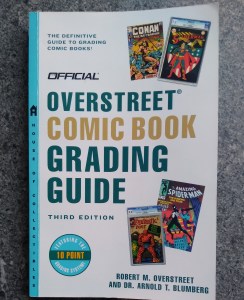
To determine a comic’s value you’ll need to have some idea of its grade. If the comic is raw, i.e. not professionally graded and slabbed (encased in plastic) then you’ll need to estimate the grade . Here are some tips to help.
Please note – grade estimates can vary among graders. I base my grading decisions on information in the Overstreet Comic Book Grading Guide. My copy is now pretty old (3rd Edition 2006), like me!
Simple Summary of Comic Grades
The basic grades from low condition to high condition are PR (Poor) FR (Fair) GD (Good) VG (Very Good) FN (Fine) VF (Very Fine) NM (Near Mint) and M (Mint).
Any of the grades from GD to NM can have a plus (high) or minus (low) assigned, for example VF+ is a high Very Fine and NM- is a low Near Mint.
Between Fair and Mint there are also “split” grades such as VF/NM. Eg a VF/NM comic is between a VF and a NM issue, i.e. better than VF+ and lower than NM-.
There is also a numerical scale value for each grade, running from 0.5 (PR) up to 10 (GM Gem Mint). Steps tend to be 0.5 toward the middle of the scale but some jumps of 0.1 and 0.2 are found.
Useful to remember are: GD 2.0, VG 4.0, FN 6.0, VF 8.0, VF/NM 9.0, and NM 9.4.
| Grade | What is typical in this grade range |
| NEAR MINT RANGE 9.8 NM/M 9.6 NM+ 9.4 NM 9.2 NM – | Few if any signs of aging or wear. Looks “like new.” 1-4 tiny defects may be visible on close inspection. Flat. Glossy. Sharp corners. Staples often shiny. No colour-breaking creases. Little to no spine stress. Often with white or off-white pages. Minor manufacturing flaws. |
| VERY FINE RANGE 9.0 VF/NM 8.5 VF+ 8.0 VF 7.5 VF- | Subtle signs of aging or wear. “Excellent condition.” Close inspection needed to find defects. 4-8 minor defects, possibly including small production defects, small bends, small dents, one small colour-breaking crease, tiny chips, subtle spine stress, slightly blunted corners, dulled staples, pages cream to yellowish. |
| FINE RANGE 7.0 FN/VF 6.5 FN+ 6.0 FN 5.5 FN- | Multiple accumulated small signs of aging or wear. “Above average.” Some surface/spine/ edge wear now immediately noticeable. Multiple small defects, possibly including bends, dents, small tears, small colour-breaking creases, spine stress, minor soiling, foxing, marks, slightly abraded corners, tarnished staples, pages creamy/tanned/yellowing. |
| VERY GOOD RANGE 5.0 VG/FN 4.5 VG+ 4.0 VG 3.5 VG- | Obvious signs of aging and wear. “Tired/worn condition.” Defects may include small stains, stickers, writing, soiling, large creases, spine roll, small spine splits, moderate tears, small missing pieces, staple pull-through, partial centrefold or cover detachment, corners rounded or small bits missing, areas of water damage, mild staple rust, yellow pages. (Interior and covers complete with no cutouts.) |
| GOOD RANGE 3.0 GD/VG 2.5 GD+ 2.0 GD 1.8 GD- | Prominent aging, wear, and damage. “Seen better days.” Defects may include significant staining, writing, soiling, creasing, spine role, tears, larger missing pieces, mildew, chew damage, water damage, a degree of page/cover browning or partial brittleness, missing corners, moderate staple rust. (Interior readable and complete with no cutouts. ) |
How To Grade a Comic Book – 1st Steps
Look for the comic’s defects You can’t accurately grade a comic from a photograph or if it’s in a bag. You’ll have to handle it. First wash and dry your hands – you don’t want to leave oily fingerprints or sweat stains behind, but you do want to be able to feel for dents, imperfections,…
Keep reading
 Buy Comics in NZ – Crazy1